Introduction: The Ground is Shifting
For the past few years, the world has been captivated by the power of large language models. Systems like ChatGPT have dominated the public conversation, reshaping our understanding of what artificial intelligence can do with words, code, and images. But while we were focused on the eloquence of chatbots, a more profound, less-visible shift has been taking place. As one recent online discussion noted, the “vibe has completely changed” in the AI industry.
The focus is pivoting from “language AI” to “physics AI” – systems designed not just to process information, but to understand, predict, and act in the complex, unforgiving reality of the physical world. This article explores five of the most impactful and surprising takeaways from this transition, revealing how AI is moving beyond our screens and into our environment.
AI is Learning Real-World Physics, Not Just Word Probabilities
To understand this shift, you first have to grasp the fundamental difference between how a popular language model works and the goal of “physics AI.” Large Language Models (LLMs) are masters of statistical prediction; they are trained on vast amounts of text to become incredibly good at guessing the next most probable word in a sequence.
The next frontier for AI is to move beyond probability and learn the “ground truth” – an intrinsic, deterministic understanding of how the world actually works. For physics AI, ground truth isn’t just about correct information, but about the unbreakable rules of the physical world: gravity, momentum, cause-and-effect. A Reddit user powerfully illustrated this distinction:
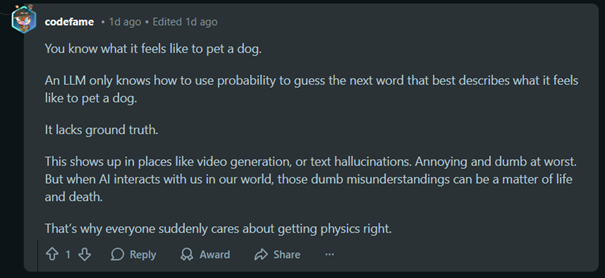
This shift is critical for applications like autonomous vehicles and robotics. In the physical world, a misunderstanding of physics isn’t just a factual error; it’s a potential catastrophe. For AI to act safely, it can’t just guess what happens next – it has to know.
The Revolution Has Been Happening “Below the Dashboard”
The recent acceleration in physical AI can feel like it happened “almost overnight,” as noted in the Reddit discussion. But this perception obscures a deeper reality. According to a report from Tata Consultancy Services (TCS), this transformation is not sudden but is the result of years of foundational work that has been largely invisible to consumers.
Industries like automotive have been quietly rebuilding their core systems around intelligence. This intensive work was concentrated “upstream,” far from the customer interface, turning factories into “cognitive assets” and evolving vehicles into “connected Physical AI assets.” The goal was to translate intelligence from “design intent into real-world outcomes,” a process that is only now becoming tangible.
The TCS report summarizes this “invisible revolution” perfectly:
The automotive industry has been rebuilding “below the dashboard” first. The biggest change has not been what drivers can see – it has been the intelligence embedded upstream in engineering systems, factories, enterprise workflows, and compliance platforms. This is why progress looked incremental, even while the system was being re-wired.
This hidden groundwork is why the industry is now reaching an inflection point. Vehicles can evolve through software updates and entire fleets can learn collectively because the underlying architecture was redesigned years ago. This re-wired foundation didn’t just enable new kinds of cars; it demanded a new kind of creator.
Developers Are Becoming AI Teachers, Not Just Coders
This new era of physical AI is also radically changing how complex systems are built. The traditional model of programmers writing explicit, rule-based code is being replaced by a new paradigm: training.
Tesla’s Full Self-Driving system provides a prime example of this shift. Instead of relying on hundreds of thousands of lines of manually written, rule-based code, the system is architected around 48 neural networks that learn directly from vast amounts of real-world driving data. Instead of being programmed for every possible scenario, the system develops “emergent behaviors” – capabilities it was never explicitly taught, like navigating complex construction zones, that arise from learning patterns in the data.
This shift positions developers less as coders and more as teachers. Their job is to curate better training data and design more effective learning models. This strategy is central to NVIDIA’s approach with its Alpamayo models, which are described as “large-scale teacher models.” These powerful models are not intended to run directly in a vehicle; instead, they are used to train and distill knowledge into the smaller, more efficient AI systems that do.
As NVIDIA CEO Jensen Huang stated in his CES keynote, this represents a fundamental reset for the entire industry. Every 10 to 15 years, the computer industry resets. This time, you no longer program the software – you train it.

The Real Challenge Isn’t the Highway, It’s the “Long Tail”
Despite the rapid progress, the common perception that autonomous driving is a nearly solved problem is misleading. The real challenge has never been standard highway driving; it’s mastering the “long tail.”
The long tail, as detailed by NVIDIA and industry analysts, refers to the enormous range of rare, complex, and unpredictable scenarios that autonomous systems must handle safely. These are the edge cases – a deer jumping into the road at dusk, a construction worker waving confusing signals, a child chasing a ball between parked cars – that traditional, rule-based systems struggle with because they cannot be pre-programmed.
To solve this, a new approach is needed – one that moves beyond simple recognition, which classifies objects, to reasoning, which predicts intent and consequence. NVIDIA’s Alpamayo is designed for this specific challenge. It uses a technique called “chain-of-thought” reasoning, allowing the system to think through novel scenarios step-by-step. This moves beyond thinking “that is a person” to “that person might step into the road, so I should slow down and create more space.”
Crucially, the goal is not just performance but also “explainability.” The ability of the system to explain the logic behind its decisions is critical for validating its safety and building public trust. As one industry analyst put it, “Autonomy only scales when systems can reason about the unexpected and explain their choices.”
The “ChatGPT Moment” for AI That Interacts With the World Is Here
The convergence of these trends – massive datasets from connected fleets, incredibly powerful computing hardware, and new reasoning-based AI models – is creating a major inflection point. This is the moment where the exponential progress seen in language models begins to translate to AI that operates in the physical world. NVIDIA CEO Jensen Huang framed this breakthrough in a direct and powerful statement at CES:
The ChatGPT moment for physical AI is here – when machines begin to understand, reason and act in the real world.
In practical terms, this means that robotics, autonomous vehicles, and other forms of “embodied AI” are poised for the same kind of rapid, transformative growth that language AI experienced over the last few years. According to Huang, robotaxis are expected to be among the first major beneficiaries of this new era, as AI shifts from being a tool that processes information to one that performs actions.
Conclusion: From Information to Action
The landscape of artificial intelligence is changing once again. For years, the conversation has been dominated by AI’s ability to manipulate language and information. Now, the industry’s focus is shifting to the much harder problem of mastering physics and interacting with the real world. This transition redefines our relationship with technology. It marks the shift from AI as an informational tool to an active participant in our physical environment, built on years of hidden industrial groundwork and a new paradigm where developers teach systems rather than programming them. By focusing on reasoning, this new wave of AI aims to solve the hardest real-world problems, fundamentally altering everything from transportation to manufacturing. The last few years taught us what happens when AI can master language. What will the next few years look like when it begins to master the physical world?
Further Readings
- Nvidia at CES: Alpamayo signals the real arrival of physical AI : https://siliconangle.com/2026/01/05/nvidia-ces-alpamayo-signals-real-arrival-physical-ai/
- FULL KEY NOTE: NVIDIA CEO Jensen Huang Speaks at CES in Las Vegas | AI & Tech Future | AI15 : https://www.youtube.com/watch?v=7YdhAsvoCao
- NVIDIA Announces Alpamayo Family of Open-Source AI Models and Tools to Accelerate Safe, Reasoning-Based Autonomous Vehicle Development: https://nvidianews.nvidia.com/news/alpamayo-autonomous-vehicle-development